
Our radon measurement quality control programme is based on verifying the readings obtained with the passive detection systems we use to provide radon measurement services (long- and short-term electret chambers, CR-39 track detectors and LR-115 track detectors), as well as on participation in intercomparison exercises.
We verify the accuracy of passive system measurements by comparing their readings with those recorded by a professional radon monitor with a valid, traceable calibration certificate.
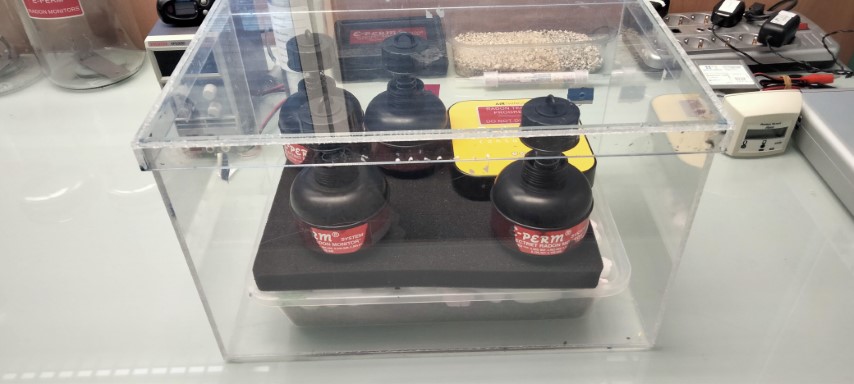
To carry out these checks, we maintain a radon chamber that allows detectors to be exposed to a stable concentration of approximately 1000 Bq/m3. This value simulates an unfavourable radon concentration that could be encountered in real situations. In general, radon chambers used for calibrations and intercomparisons employ much higher concentrations, for example 40 000 Bq/m3, in order to obtain faster readings. Our chamber, on the other hand, allows the behaviour of radon detectors to be studied under conditions that are more representative of real scenarios.
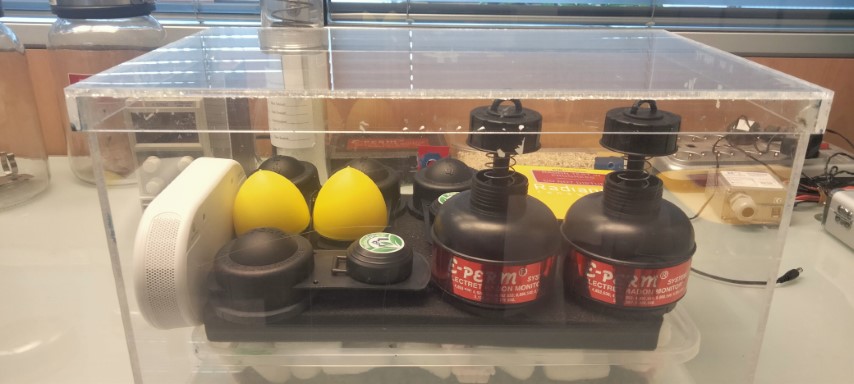
The purpose of this controlled test was to verify the readings obtained with our short-term radon measurement system (with a typical sampling period of seven days). Our system is based on E-PERM ionisation electret chambers, using the SST configuration: a short-term electret (ST electret) and a short-term chamber (S chamber).
The reference instrument is the Corentium Pro, serial no. 2700005925, with the last calibration dated 22/10/2024. (see calibration certificate).
| Test period: | 05/03/2025 - 13/03/2025 (7 days, 18 hours) |
| Test systems: | SST electret chamber |
| Reference equipment: | Corentium Pro |
| Gamma dose rate: | 0.10 µSv/h |
| Relative humidity: | 55% |
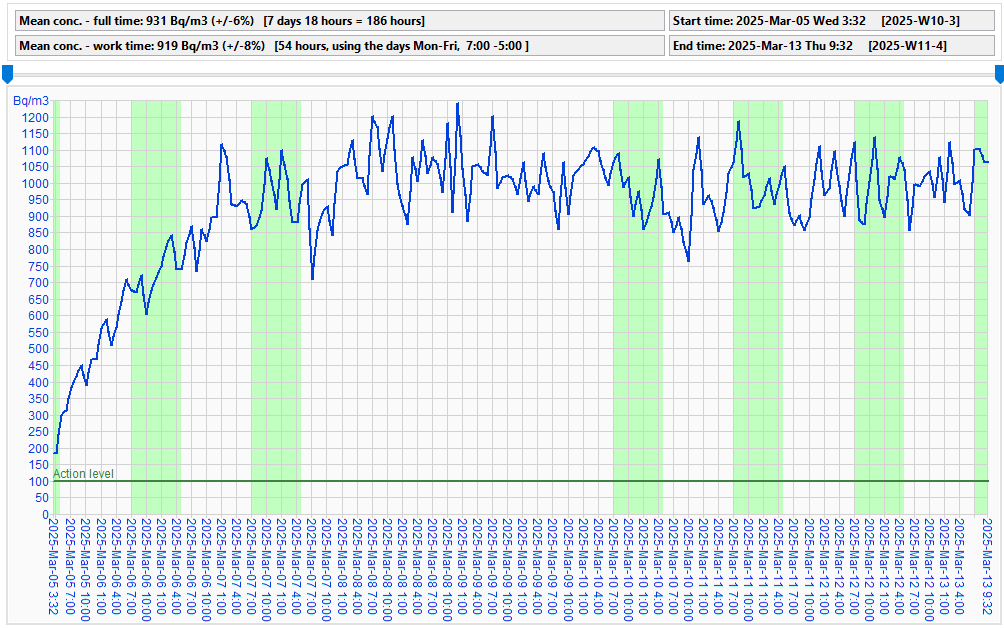
The hourly updated radon concentration readings during the test period are shown below. The average level recorded by the reference instrument during the test period was 931 Bq/m3 ± 6%.
| System | Detector ID | Radon Bq/m³ |
|---|---|---|
| EPERM SST | SOH179 | 944 ± 47 |
| EPERM SST | SOI179 | 966 ± 49 |
| EPERM SST | SOB179 | 871 ± 44 |
| EPERM SST | SOH550 | 928 ± 47 |
| AVERAGE: | 927 ± 23 |
In the following table, the average radon measurement obtained with each system is compared to the reading of the calibrated instrument:
| System | Radon Bq/m3 | Deviation |
|---|---|---|
| Reference equipment | 931 | n/a |
| EPERM SST | 927 ± 23 | 0.43% |
In this test we compared the readings obtained with passive measurement systems (CR-39 track dosimeters and E-PERM LLT electret chambers) with those of the reference instrument Corentium Pro, serial no. 2700005925, last calibrated on 22/10/2024. (see calibration certificate).
| Test period: | 25/11/2024 - 27/02/2025 (93 days, 23 hours) |
| Test systems: | CR-39 tracks, LLT electret chamber |
| Reference equipment: | Corentium Pro |
| Gamma dose rate: | 0.10 µSv/h |
| Relative humidity: | 55% |
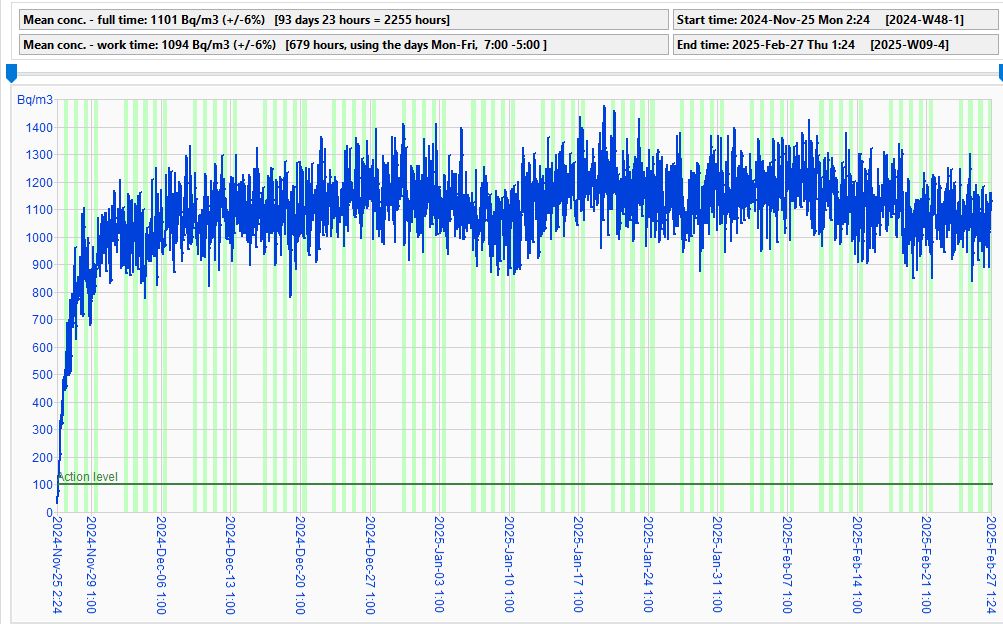
The hourly updated radon concentration readings during the test period are shown below. The average level recorded by the reference instrument during the period was 1101 Bq/m3 ± 6%.
| System | Detector ID | Radon Bq/m³ |
|---|---|---|
| RAC CR-39 | 123562 | 1061 ± 74 |
| RAC CR-39 | 123495 | 1078 ± 75 |
| EPERM LLT | LT9277 | 1165 ± 61 |
| EPERM LLT | LX7887 | 1114 ± 59 |
In the following table, the average radon measurement obtained with each system is compared with the calibrated instrument reading:
| System | Radon Bq/m3 | Deviation |
|---|---|---|
| Reference | 1101 | n/a |
| RAC CR-39 tracks | 1070 | 3% |
| EPERM LLT electrets | 1140 | 3.5% |
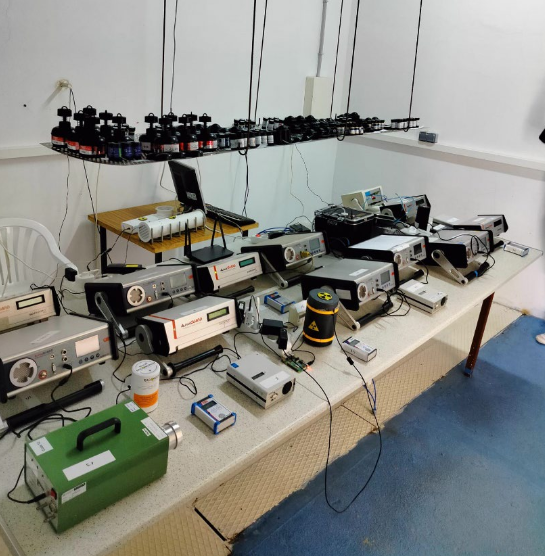
As part of our quality programme, we participate in radon measurement intercomparison exercises. In May 2024, we took part in an international intercomparison organised by the Environmental Radioactivity Laboratory of the University of Cantabria (LaRUC). A total of 39 radon measurement services from various countries participated, using both active and passive detectors. Radiansa Consulting took part using our RAC CR-39 passive track detector system.
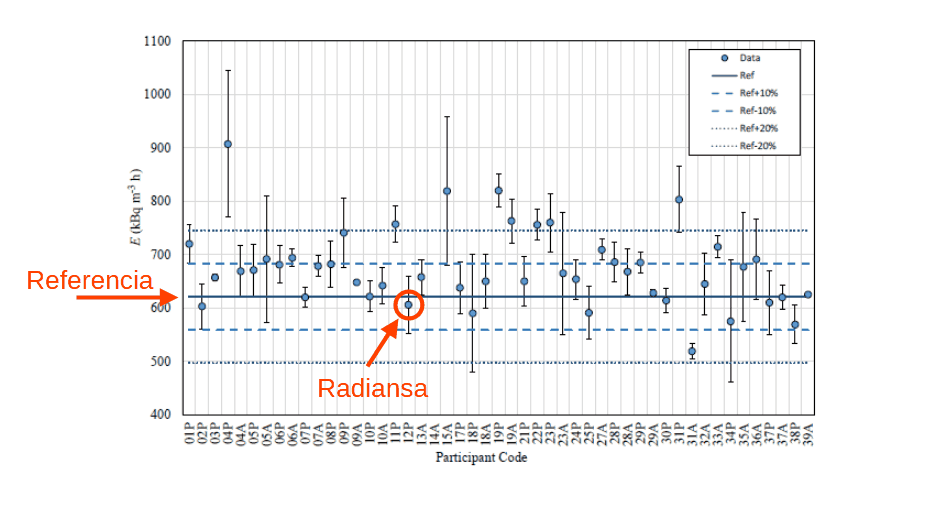
The results obtained with Radiansa’s CR-39 track detectors are shown in the following graph. The reference value was 621 kBq/m3·h, while the average value of the ten Radiansa detectors exposed was 606 kBq/m3·h, representing a deviation of 2.4% from the reference value. This result was among the most accurate recorded by the 28 participants who used passive detectors.
Radon gas:
This website uses third-party cookies (Google Analytics) to obtain navigation statistics from site users anonymously; navigating our website implies acceptance of our cookie policy.